

Finding the Best Pure White Resin for BJDs
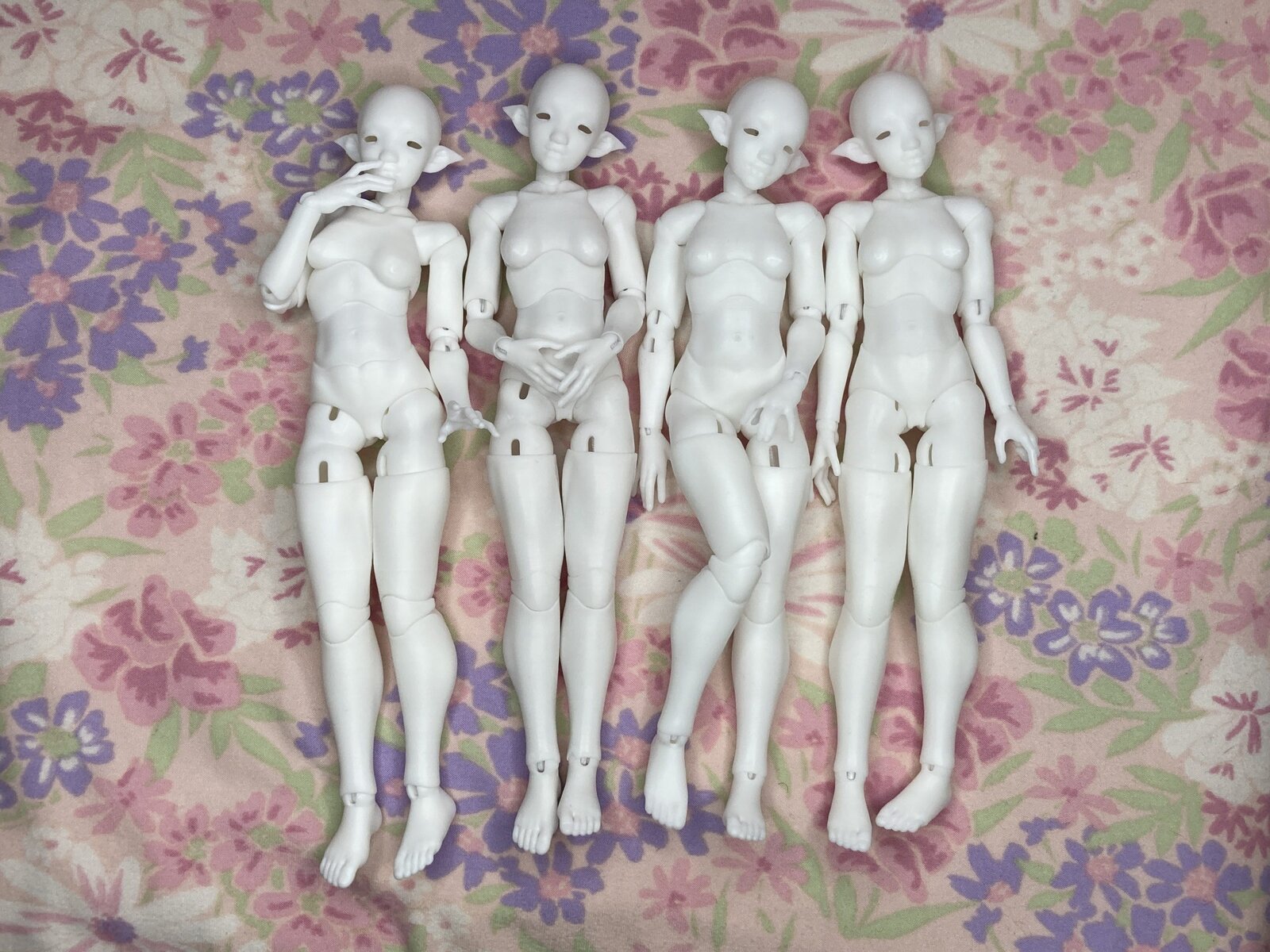
This is specifically for PURE WHITE resins. Not cream white, not off-white, JUST WHITE.
White is a difficult color to pull off, and the way these resins perform is not a perfect representation of how other colors from these brands will behave.
I do not have infinite money to test every type of white resin out there. With that said, I will be updating this list over time as I do more testing! New resins will be added soon, along with combinations of promising resins to find the best mix.
The doll featured in this post is VivifyDolls Alister (Adult vers.) on the Acrobat Body.
Pure White Resins Graded
| Resin | Bottom Exposure | Exposure | Cost | Drop Test Results | Print Ease | Finish | Grip | Scratch Resist | UV Resist | Detail | Precision/Deformation | Flaws | Brightness | |
|---|---|---|---|---|---|---|---|---|---|---|---|---|---|---|
| Resione TH-BJD | 100 | 3 | $$ | 2 ft | D | C | F | A | A | B | C | F | A | |
| Elegoo ABS-like 1.0 | 40 | 4 | $ | – | A | A | A | B | B | C | B | A | B | |
| Chitusystems Conjure Rigid | 40 | 4 | $ | 4 ft | A | C | C | C | B | D | C | A | B | |
| Anycubic DLP Craftsman | 50 | 2 | $$ | 7 ft | B | D | B | D | C | A | A | D | A | |
| Sunlu ABS-like | 40 | 2 | $ | – | B | C | A | F | B | D | C | C | A | |
| Elegoo ABS-Like 3.0 | 40 | 3.5 | $ | 2 ft | A | A | B | C | C | D | C | A | C | |
| Elegoo ABS-Like 3.0 PRO | 40 | 3.5 | $ | 4 ft | A | A | A | B | B | B | B | B | C | |
| Elegoo ABS-Like 3.0 + | 40 | 3.5 | $ | 3 ft | A | A | B | C | B | C | B | A | C | |
| Anycubic ABS-Like v2 | 60 | 2 | $ | 6 ft | B | B | D | B | A | C | C | A | B |
Once this table gets difficult to navigate, I’ll set it up so you can organize rows by whichever parameter you choose, but I don’t want to do that right now.
I might also try to color-code it to make it easier to skim, but that might be a nonissue for anyone who isn’t dyslexic…
Ranking Categories–What I’m Looking For and How They’re Graded
Keep in mind this is only in regards to WHITE RESIN. Results and ratings may differ with different colors of the same brand/type.
Exposure
This category doesn’t get ranked, it’s just to provide extra information.
These are the settings at which I got the best results with each particular resin, printed at 0.03 Layer Height on my Saturn 3 Ultra.
Cost
Price per kg, as recorded on the day of purchase without taking bulk pricing or sales prices into consideration.
Remember that prices are subject to change and I will not be updating price figures over time.
Roughly:
$ = $0-30
$$ = $30-60
$$$ = $60-100
$$$$ = $100+
Drop Test
Drop tests are conducted on an assembled 17 cm doll against a linoleum floor.
Dolls weigh an average of 1.5 oz (or about 42.5 g)
Dolls are dropped at 1 foot intervals between 1 and 7 feet. Each drop is conducted 3 times.
The values represent the height at which any part of the doll breaks (in feet).
If the field is blank, then the doll did not break throughout any of the tests.
Print Ease
Determined by factors such as printing temperature and the range of exposure times that would result in an acceptable print. It also takes into account the likelihood of misprinting and the circumstances in which that occurs.
AKA how beginner-proof is it?
A – Extremely easy to use. You just throw it in your printer and start it up, likely getting a successful print on your first try with default settings. Resin is likely to behave well at a wider variety of temperatures and exposure times.
B – Easy to use, but may have one or two specific parameters or a narrow exposure window to get it to work right. May also apply to resins that are easy to print with, but difficult to get ideal results with.
C – Can be a challenge to get dialed in, but certainly workable.
D – Extremely difficult to dial in or get consistent results with.
F – Nearly impossible to work with and get acceptable results, or the difficulty in dialing it in exceeds my time and resources.
Finish
This is in regards to the texture of the finished resin. This takes into consideration the way it feels, the visibility of the layer lines, and how matte or shiny the pieces are.
Tests are done at 0.03 mm layer height with Anti-Aliasing turned OFF.
A – The pieces are matte and have no or few visible layer lines.
B – Pieces are overall mostly matte with few visible imperfections or layer lines.
C – Pieces are moderately shiny with moderate layer lines, or significantly shiny with no layer lines, or matte with significant layer lines. May be improved with Anti-Aliasing or post-processing techniques.
D – Pieces feature significant layer lines and moderate to significant shininess. Cannot be fixed with Anti-Aliasing or post-processing techniques.
F – Pieces are very shiny and have significant layer lines. Prints may feature random imperfections such as scraggly lines or dents and divots. Extensive sanding is the only option for fixing it.
Grip and Posing
This section is really specific to BJDs, since the texture of the resin will determine how well the doll will hold poses that go against the pull of gravity, such as kicking a leg back, touching their face, raising their arms above their head, etc.
A – Resin is textured and grippy, and the doll is able to hold a large variety of poses with no effort.
B – The doll is able to hold most poses well with little effort.
C – The doll is able to hold most poses, but it takes some effort to get them to pose.
D – The doll is unable to hold most poses, and they take considerable time and effort to pose.
F – The resin has no grip and the joints slide too easily. The doll is completely unable to pose and will always fight to curl up in the position of least resistance.
Scratch Resist
Tested using the top of the hip joint and the hip socket in the butt piece as well as the knee joint and knee socket in the thigh. This is due to the fact that neither joint nor socket has any support marks on it for either option, so the dust level can be accurately tested prior to sanding.
NOTE:: This is harder to see with white resin, so the ratings here are more forgiving than they would be with other colors.
A – There is no sign of dust, regardless of how hard the pieces are rubbed together. Pieces can only be scratched with a metal instrument, not other resin or fingernails.
B – There is some dust, but only when the pieces are rubbed together in a way that would not happen under normal circumstances. Pieces can be scratched, but it is not excessive and it can be avoided with careful handling.
C – There is some dust accumulating under normal circumstances, but it is not excessive and easy to wipe away. The resin may be scratched with other resin pieces or fingernails.
D – Significant dust appears in the joints with regular posing. The resin may be easy to scratch with other resin pieces or fingernails.
F – Dust immediately appears in the joints upon moving them for the first time. Dust is significant and impossible to keep under control. Doll is constantly scratching itself and no amount of careful handling can totally prevent this.
UV Resist
UV tests are conducted in an Elegoo Mercury X cure station.
Prints are post-cured for 90 seconds (or manufacturer’s recommendation) to be safe for handling.
Tests are conducted at 5 / 10 / 30 minutes.
Prints are left to sit out for at least 24 hours before being surveyed for discoloration.
A – Resin shows minimal discoloration after 30 minutes in the cure station.
B – Resin shows minimal discoloration after 10 minutes in the cure station, or significant discoloration at 30 minutes.
C – Resin shows minimal discoloration after 5 minutes in the cure station, or significant discoloration at 10 minutes.
D – Resin shows significant discoloration after 5 minutes in the cure station.
F – Resin shows discoloration after the post-cure 90 seconds.
Details
A – Resin shows an excellent preservation of detail.
B – Resin shows an acceptable preservation of detail.
C – Resin shows an average or expected preservation of detail.
D – Resin shows poor preservation of detail.
F – Resin shows an extremely poor preservation of detail. Pieces are likely to look bloated or melty, with crevices and fine details getting blurred or bubbled.
Deformations
A – Joints fit well with no sanding, and there are no signs whatsoever of warping or deformation.
B – Joints fit well with limited sanding, and there are no obvious signs of warping or deformation.
C – Joints may require minor sanding to fit, or the pieces may feature mild deformations or evidence of shrinkage/expansion.
D – Joints may require significant sanding to fit, or the pieces may show some moderate deformations or evidence of shrinkage/expansion.
F – Joints do not fit and may or may not be fixable with sanding. Pieces are significantly deformed.
Flaws
A – The resin is free of blemishes, bubbles, lumps, or other flaws.
B – Resin may feature minor blemishes, bubbles, lumps or other flaws, but they could be easily sanded away.
C – Resin may feature moderate blemishes, bubbles, lumps, or other flaws that may or may not be sanded away.
D – Resin may feature multiple blemishes, bubbles, lumps, or other flaws. It would be difficult or time consuming to sand everything away, and doing so may compromise the shape of the parts.
F – Resin is significantly flawed and features many blemishes, bubbles, cracks, crevices, dents, lumps, or other flaws that cannot be removed without significant restoration.
Brightness
A – Resin is bright, neutral white and very opaque.
B – Resin is either bright neutral white and semi-translucent, or neutral white and very opaque.
C – Resin is slightly dull or off-white, but still very opaque OR neutral white and fairly translucent.
D – Resin is dull or off-white and semi-translucent.
F – Resin is very off-white, yellow, or grayish. May be opaque or semi-translucent.